- Introduction
- Can You Travel in Korea Without Cash?
- What Works Best for Most Tourists?
- Using Credit and Debit Cards in Korea
- When Cash Is Still Important
- Why T-money Makes Your Trip Easier
- Where to Buy and Recharge T-money
- Can You Use Mobile Payments?
- What About Taxis?
- ATMs and Exchanging Money
- Common Payment Mistakes Tourists Make
- So What Should You Actually Do?
- Conclusion
Introduction
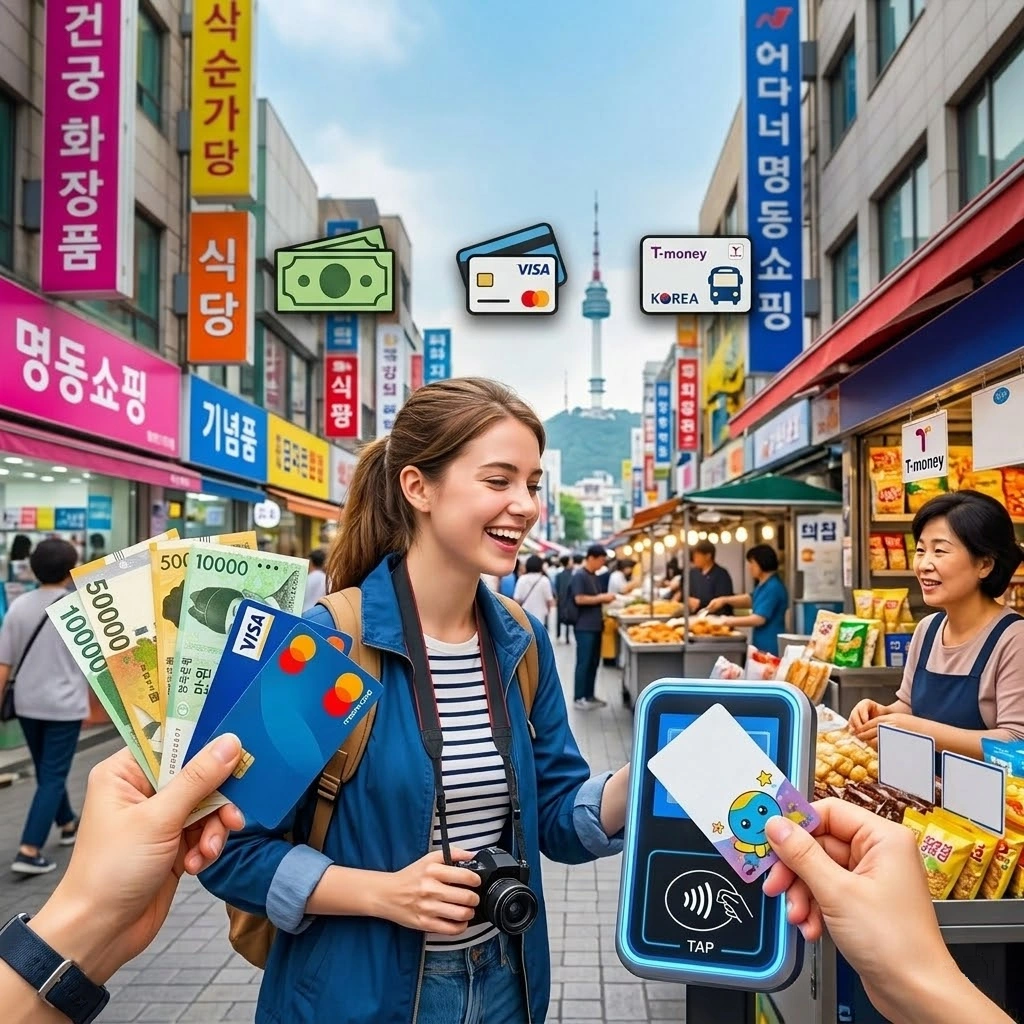
Paying for things in Korea is usually easy, but it can still confuse first-time visitors. Many travelers arrive expecting to use only credit cards, only to discover that some street food stalls prefer cash, some transportation works better with T-money, and certain international cards do not always go through as smoothly as expected.
The good news is that Korea is one of the most convenient countries in Asia when it comes to everyday payments. The key is not choosing one method, but understanding when each one works best. If you know when to use cash, when to use your card, and when a T-money card makes life easier, your trip becomes much more comfortable.
This guide explains how tourists can actually pay in Korea in real situations, from the airport and subway to cafes, markets, convenience stores, and local restaurants.
Can You Travel in Korea Without Cash?
In many cases, yes. Korea is highly card-friendly, especially in cities like Seoul, Busan, and Incheon. Most hotels, chain cafes, restaurants, department stores, convenience stores, and tourist attractions accept cards without any problem.
That said, “mostly card-friendly” is not the same as “cash-free.” Tourists often make the mistake of assuming they never need cash, and that is when small inconveniences start piling up. A street food vendor may only want cash. A traditional market stall may prefer smaller bills. Some transport-related purchases are just easier with prepaid balance rather than a foreign card.
For that reason, the smartest approach is simple: bring both a payment card and some Korean won. You do not need to carry a huge amount of cash, but you should never arrive with none at all.
What Works Best for Most Tourists?
If you want the easiest setup, use this combination:
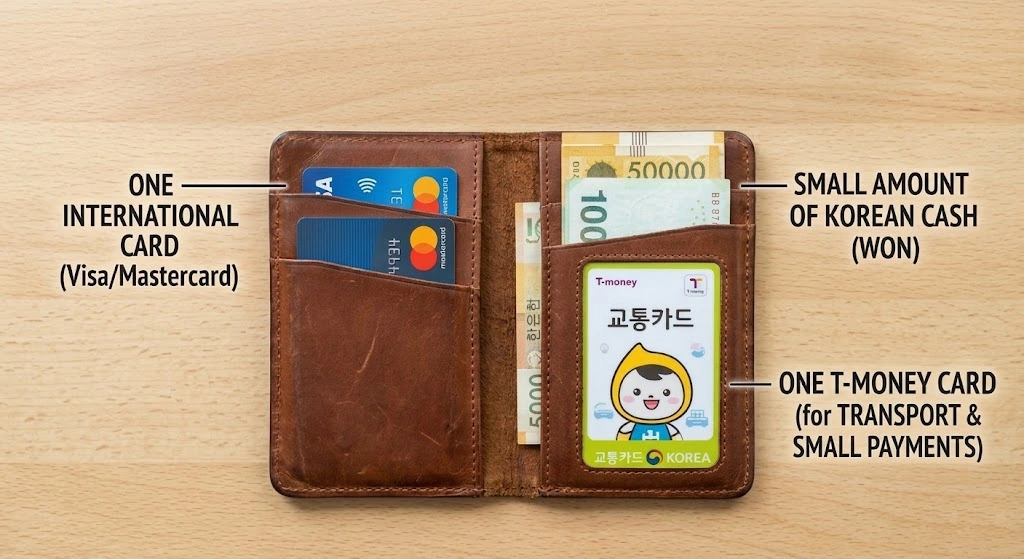
- One international credit or debit card
- A small amount of Korean cash
- One T-money card for transport and small purchases
This three-part setup covers almost everything you will do during a normal trip. Your card will handle hotels, larger meals, shopping, and most cafes. Your cash will help in markets, food stalls, and backup situations. Your T-money card will make subways and buses faster and less stressful.
Travelers who try to rely on only one payment method usually run into unnecessary friction. The goal is not maximizing simplicity in theory. The goal is making sure your day goes smoothly in practice.
Using Credit and Debit Cards in Korea
Most tourists use their credit or debit cards for the majority of their spending in Korea. This works well in most urban settings, especially for medium and large purchases.
You can usually use cards at:
- Hotels
- Restaurants
- Chain cafes
- Department stores
- Shopping malls
- Convenience stores
- Pharmacies
- Large attractions
- Branded bakeries and dessert shops
Visa and Mastercard are generally the safest options. Some travelers also do fine with debit cards, but international debit cards can occasionally be less reliable than credit cards depending on the bank and fraud settings.
Before your trip, it is worth checking three things with your bank:
- whether overseas transactions are enabled
- whether there are foreign transaction fees
- whether your card might be blocked for security reasons in Korea
A card that works perfectly at home can still trigger fraud alerts abroad. It is much better to deal with that before departure than while standing at a hotel desk or restaurant counter.
When Cash Is Still Important
Korea is modern, but cash still matters in specific travel situations. First-time visitors tend to underestimate this because so much of the country feels digital and efficient.
Cash is especially useful for:
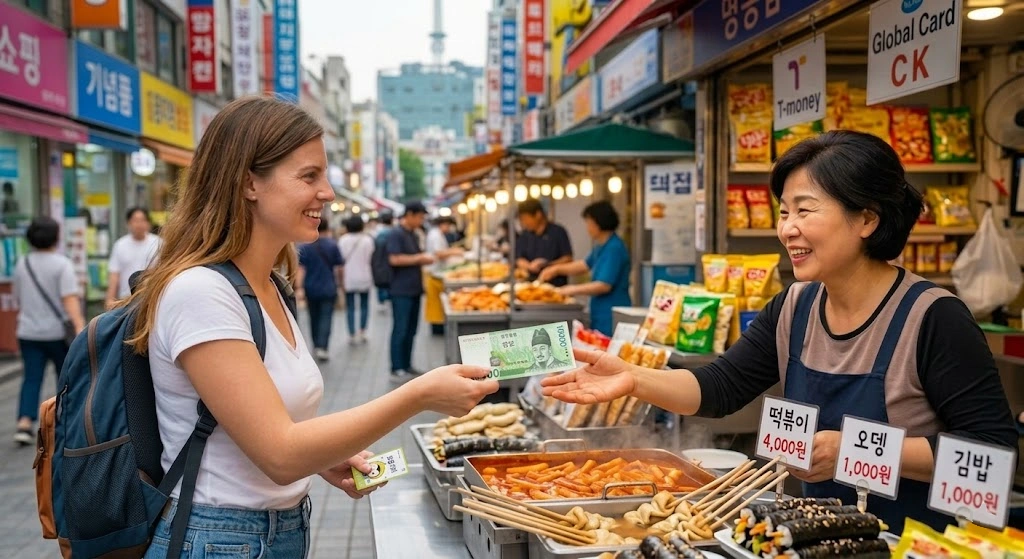
- street food stalls
- traditional markets
- very small local shops
- older neighborhood restaurants
- some intercity bus or local purchase situations
- emergencies if your card temporarily fails
If you are visiting places like Gwangjang Market, smaller neighborhood markets, or seasonal food streets, cash makes the experience easier. Even when a place technically accepts cards, cash can still be more practical for quick transactions.
You do not need to exchange a large amount at once. For many travelers, carrying a modest daily amount is enough. Think of cash as a practical backup, not your main strategy.
Why T-money Makes Your Trip Easier
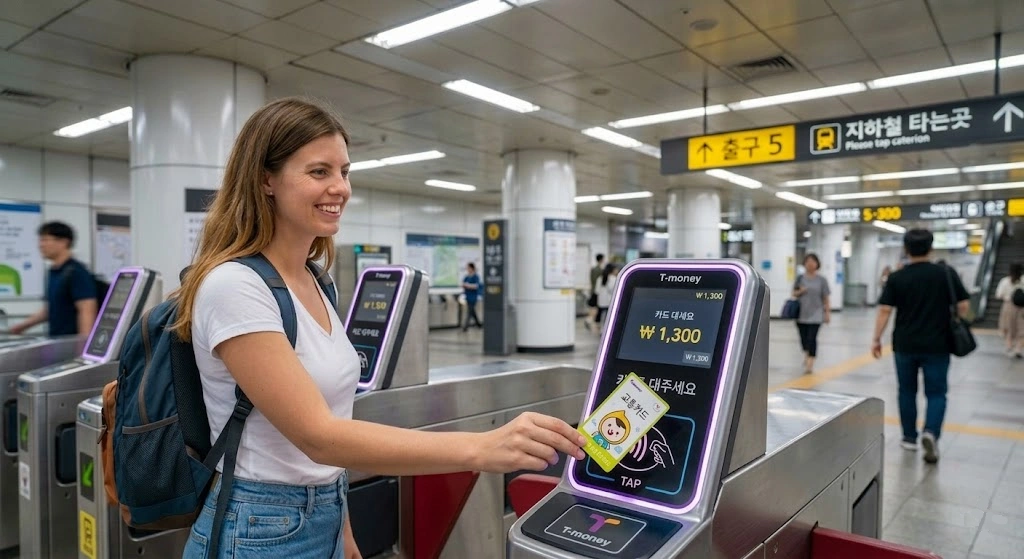
If there is one payment tool that makes everyday travel in Korea smoother, it is the T-money card. Tourists often think of it as just a subway card, but it is more useful than that.
A T-money card can be used for:
- Seoul subway
- city buses
- many taxis
- some convenience store purchases
- small transport-related payments
The biggest benefit is convenience. You do not need to keep buying single-use transport tickets, and you do not need to think about exact fares every time you switch lines or change buses. You just tap in and tap out.
That convenience matters more than most people expect. Transportation in Korea is easy once you get used to it, but anything that reduces small daily decisions helps a lot when you are tired, jet-lagged, or trying to navigate a new neighborhood.
Where to Buy and Recharge T-money
Most tourists get a T-money card at one of three places:
- the airport
- convenience stores
- subway stations
Convenience stores are often the easiest option. Once you have the card, you can recharge it with cash at many convenience stores and station machines. That is one reason it is smart to keep some cash with you even if you mostly use cards elsewhere.
A common misunderstanding is assuming T-money works like a normal international bank-linked travel card. It does not. It is a stored-value transit card. You load money onto it first, then use the balance.
If you plan to move around Seoul often, getting one on your first day is worth it.
Can You Use Mobile Payments?
For tourists, mobile payments are less reliable as a main strategy than cards and cash. Korean domestic services are highly developed, but many are built around Korean bank accounts, Korean phone verification, or local apps.
That means you should not assume a foreign traveler can use mobile payments in Korea the same way locals do.
Some international mobile wallet setups may work in certain places depending on your device, card issuer, and payment terminal, but I would not recommend building your whole trip around that expectation. For most visitors, mobile payments should be treated as a bonus if they work, not a core system.
In other words, physical card plus cash is still the safest and least stressful combination.
What About Taxis?
Taxis in Korea are generally convenient, and in many cases cards are accepted. Still, this is one area where travelers feel more comfortable when they have options.
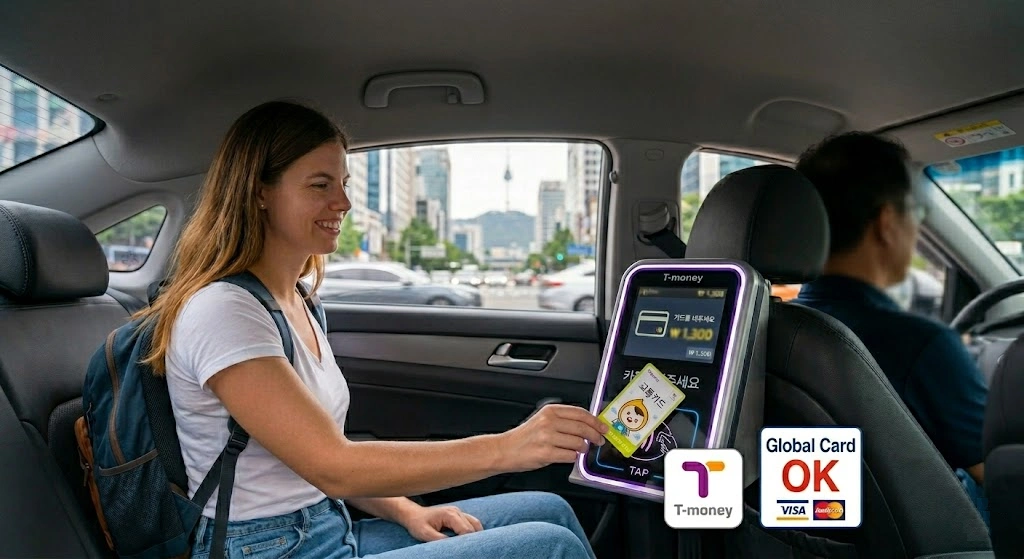
The best setup is:
- use card when possible
- keep some cash available
- use a T-money card when appropriate
- save your destination in Korean
Payment is usually not the hardest part. The bigger issue is reducing confusion during the ride. Having your destination written in Korean and keeping a backup payment method is what makes the whole process easier.
If you are arriving late at night, traveling outside central tourist areas, or dealing with a language barrier, backup options matter.
ATMs and Exchanging Money
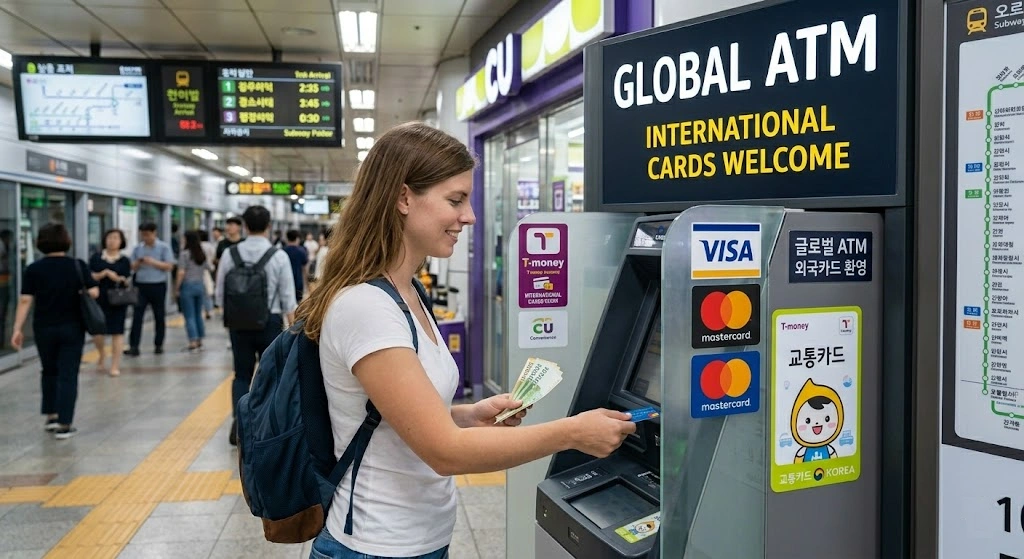
Tourists usually get Korean won in one of two ways:
- exchange money before or after arrival
- withdraw cash from an ATM
Both can work, but convenience depends on your card and your bank. Some international cards work smoothly at global ATMs, while others are inconsistent. Airport exchange is simple but not always the cheapest option. City exchange counters may offer better rates, but that requires extra time and planning.
For most short trips, the practical solution is to arrive with a little cash or exchange enough for the first day, then adjust as needed once you settle in.
Do not spend too much time trying to optimize every won. Convenience is usually more valuable than a tiny exchange-rate difference, especially on a short stay.
Common Payment Mistakes Tourists Make
The most common mistakes are small, but they create avoidable stress.
Assuming cards work literally everywhere
They work in many places, not all places.
Arriving without cash
This becomes annoying the moment you want street food, a market snack, or a quick recharge.
Not getting T-money early
This makes your first few subway and bus trips more complicated than they need to be.
Relying too much on mobile payment expectations
What works in your home country may not work the same way in Korea.
Carrying only one card
Always have a backup if possible.
These are not dramatic travel disasters, but they are exactly the kinds of issues that make first-time visitors feel more lost than they need to.
So What Should You Actually Do?
If you want the short practical answer, do this:
Bring one reliable international card, keep some Korean won with you, and buy a T-money card as early as possible.
That setup is simple, realistic, and flexible. It works for the vast majority of travelers and avoids almost all payment-related stress.
Conclusion
Paying in Korea is not difficult, but it
Use your card for most daily spending, keep some cash for smaller or more traditional places, and let T-money handle transportation. Once you do that, one of the most confusing parts of a first trip to Korea becomes surprisingly easy.